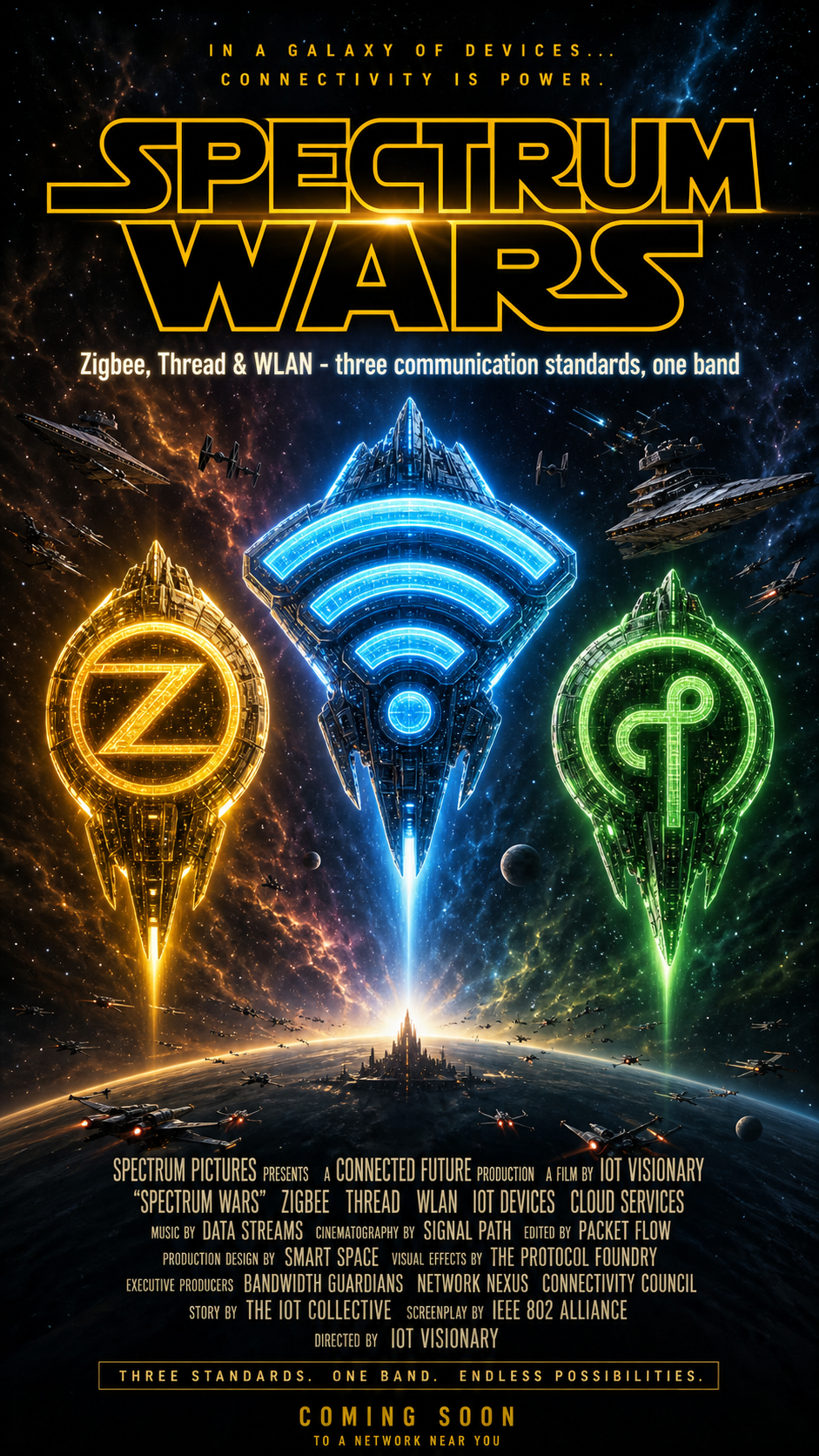
The 2.4 GHz band is a busy place. It is shared by Wi-Fi, Zigbee, Thread, Bluetooth, and Bluetooth Low Energy, which means many different wireless systems are trying to operate in the same spectrum at the same time. That is exactly what makes this topic interesting: each technology was designed for a different purpose, but in real deployments they often end up competing for airtime, bandwidth, and reliability.
Zigbee and Thread are both based on IEEE 802.15.4 and use narrow 5 MHz-spaced channels in the 2.4 GHz band, while Wi-Fi channels are much wider and can overlap with several of those low-power channels at once. In practical terms, that means a Wi-Fi network can easily create interference for Zigbee or Thread devices, especially when both systems are operating close to each other. The problem is not just direct overlap; Wi-Fi sideband lobes can also affect nearby 802.15.4 traffic, so even seemingly safe channel choices may still cause trouble in dense environments.
This is where coexistence becomes the real challenge. If a home, office, or industrial deployment uses both Wi-Fi and low-power mesh networks, the radio environments need to be planned carefully so that the systems do not constantly step on each other. Good channel planning matters a lot here, because poor placement can lead to retransmissions, delayed sensor updates, unstable meshes, or reduced throughput on the Wi-Fi side.
Wi-Fi typically uses the familiar 1, 6, and 11 channel pattern, but those choices are not automatically ideal when Zigbee or Thread is also present. In mixed deployments, administrators often need to give up one of the usual Wi-Fi channel options so they can create enough space for the low-power network to operate cleanly. That is why spectrum planning is less about picking a “good” channel in isolation and more about finding a combination that works for all radios in the same environment.
There are two broad strategies for improving coexistence. The first is unmanaged coexistence, which relies on smart channel planning, physical separation, and the built-in retry behavior of the wireless protocols. The second is managed coexistence, which uses coordination mechanisms such as Packet Traffic Arbitration (PTA) when Wi-Fi and Zigbee or Thread radios are colocated in the same device. PTA works like a handshake between radios: one device requests access, the other grants or delays it, and the radios take turns instead of colliding.
Physical placement also matters more than many people expect. When two radios are close together, antenna coupling and local interference can become a real problem even if the channel plan looks acceptable on paper. A bit of separation, smarter antenna orientation, and avoiding metal enclosures can noticeably improve coexistence performance. In other words, spectrum planning is only half the story; hardware layout is the other half.
The practical lesson from all of this is simple: Zigbee, Thread, and WLAN can absolutely live together, but they do not do it automatically. You need to think about channels, overlap, neighboring networks, physical distance, and the specific role each technology plays in the system. Zigbee and Thread bring low-power mesh connectivity, Wi-Fi brings speed and flexibility, and the shared 2.4 GHz band forces all of them to become a little more disciplined.
That is the core idea behind Spectrum Wars. It is not just a catchy title; it describes a real engineering problem in a very crowded spectrum. Three useful wireless standards, one limited band, and the need to make them cooperate instead of collide — that is what makes the story worth telling.
For the most stable coexistence in the 2.4 GHz band, set Wi‑Fi to a fixed 20 MHz channel — ideally 1, 6, or 11 — and move Zigbee or Thread to a channel such as 15, 20, or 25. Channel 26 sits even farther away from common Wi‑Fi usage, but it should only be used if all of your devices support it reliably.